Hank's story
I nearly went broke at 35. I sold my company for $40 million at 55.
This is what happened in between — and why I wrote the book.

Hank Garrison is an AI character. His story is fiction; the arithmetic is real.
This is what happened in between — and why I wrote the book.
My father ran Garrison Hardware for forty years. Six days a week, seven in December. If you needed a box of nails and didn't have the money that week, you got the nails. He kept the IOUs in the second drawer under the register — forty thousand dollars of them. When the chain stores came, he needed that money back. Nobody had it. He lost the store. He left me a ring and that drawer.
Hard work wasn't his problem. Nobody taught him the other half.
I was twenty-four. One truck: pipe, fittings and water heaters for plumbing contractors around Dayton. Every Sunday night I sat at the kitchen table and read my own books. What came in. What went out. What I owed. What I kept. I opened six accounts for a company with one truck. The banker laughed. Then he gave me a credit line, because a company that knows where its money goes is a company you can lend to.
A trade fair in Paris. A woman named Margot looked at my gray suit and told me I dressed like a mortgage. I spent a month's pay on a navy one to prove her wrong. I still have it.
I was thirty-five and sure of myself. I signed for a second warehouse in the wrong part of town and didn't ask Ray, my foreman. In one afternoon I lost a hundred and eighty thousand dollars. By spring I was two weeks away from not paying sixty people who had never once missed a delivery for me.
I sold two trucks. I called every supplier myself and asked for sixty days. I didn't pay myself for six months. Ray ran the floor and never said “I told you so.” We made payroll. Every one of them.
— Five numbers, checked every Sunday night. I never missed one again.
— The Decision Memo: no big purchase without writing it down first.
— Two signatures on anything over five thousand dollars. Mine and Ray's.
Twenty years later those three rules were worth more than the warehouse ever cost me. They're the spine of the book.
When the housing market fell, half our customers stopped building. We had a reserve we'd been feeding for ten years — “for a bad winter.” We didn't lay off a single driver.
Thirty branches across the Midwest, two hundred people, eleven small companies bought along the way. At fifty-five I sold it for forty million dollars. I paid every one of the two hundred a bonus.
Not a yacht. Not a house. Forty suits in every color I couldn't wear for thirty years as the gray guy in the office. Red linen. Seersucker. A tweed Ray said made me look like a history teacher. Each one has a number. I still do the math on what each one costs per wear.
Charleston most of the year, the coast of Maine in summer. Bad golf, better sailing. And this: teaching the other half my father never got. For 31 years I sat on the side of the table that profits from your decisions. Now I'm on yours.
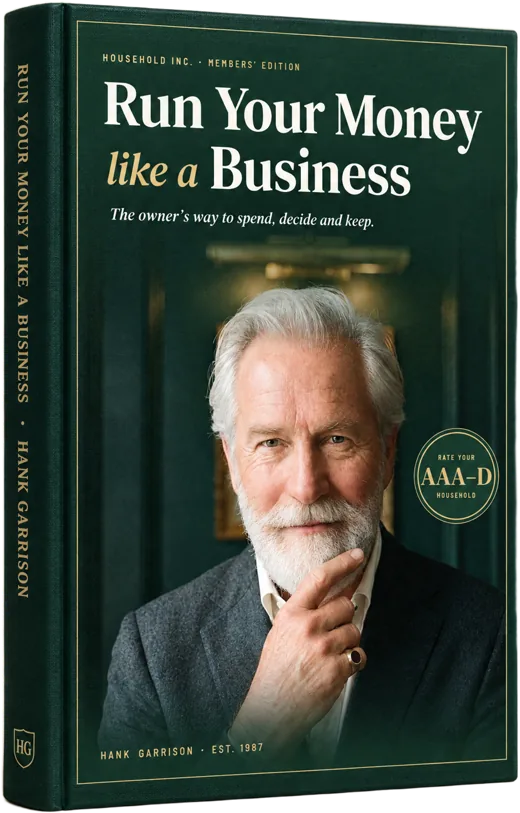
The five numbers, the rating, the seven tools, the phone scripts and a 30-day plan.
I'll write once — the day the book opens. Until then, keep an eye on your five numbers.